Series
Blogs
Series
Blogs
Authors: Jonathan Gafni, Anna Gooding, Ray Tang Hou, Bhavishya Barbhaya
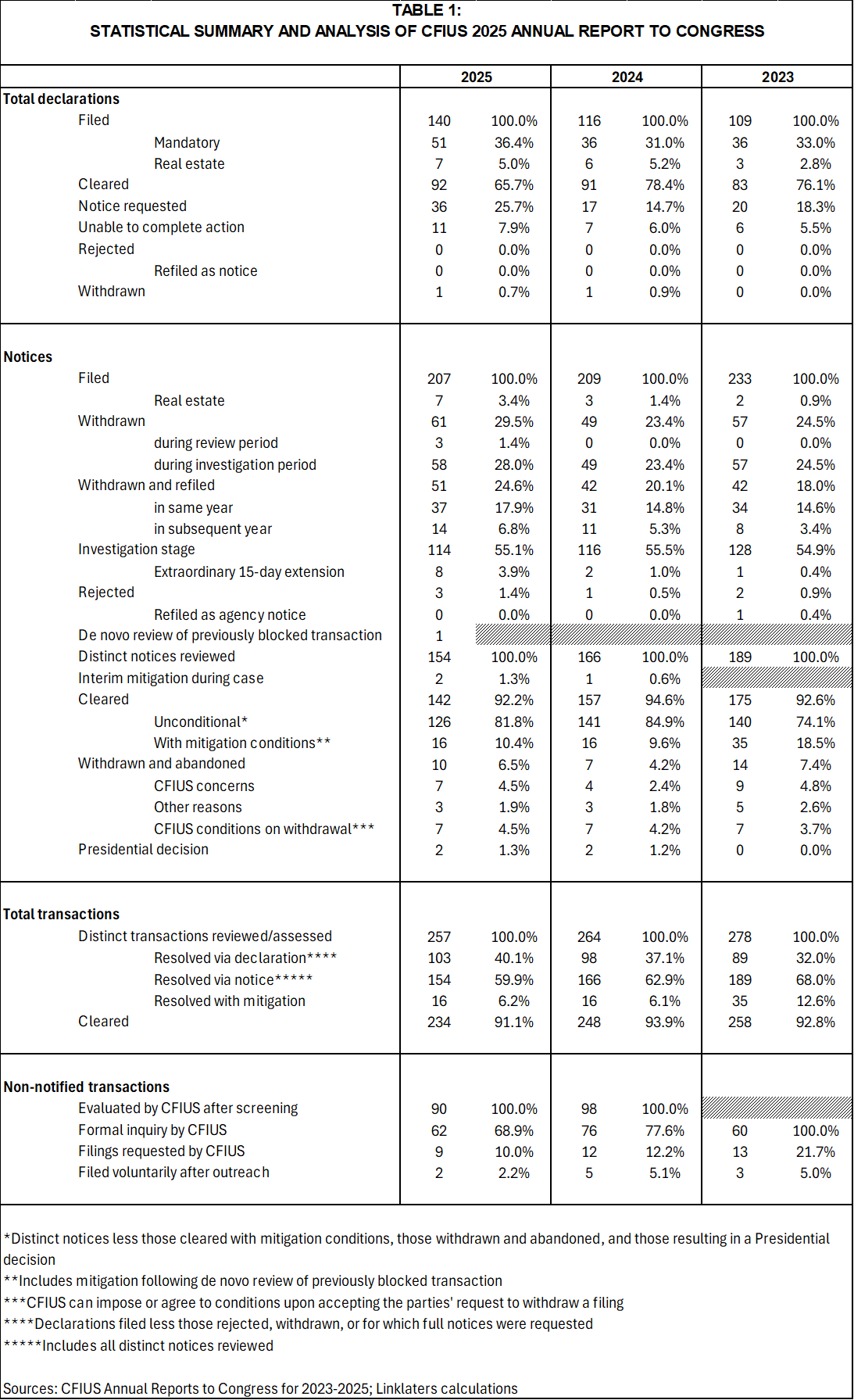
In recent years, we have reported on continuing declines in CFIUS’s caseload, as measured by the number of distinct transactions reviewed by the Committee. As illustrated in Table 1 below, CFIUS’s caseload continued to decline slightly in 2025, but we do not think last year’s decline is material in light of the U.S. government shutdown from October 1 through November 12. During the shutdown—the longest affecting the entire government in U.S. history—CFIUS was unable to accept new filings, and undoubtedly, parties ended up not bothering to submit voluntary filings for a number of transactions.
Looking ahead, we note that there have already been two partial government shutdowns in 2026, with the most significant being the 76-day shutdown of the U.S. Department of Homeland Security (DHS) from February 14 through April 30. Since DHS is a standing member of CFIUS, which generally acts by consensus, the DHS shutdown impeded the process of many CFIUS filings and cases, though CFIUS leadership attempted to mitigate the effects on transactions in which DHS did not have a substantive concern.
We also note that the U.S. Congress has not yet agreed on funding for the new fiscal year beginning October 1, 2026, and that the bills that have been passed by the two houses of Congress, but not yet reconciled, would provide funding only until early December (i.e., after the forthcoming Congressional elections in November), leaving open the possibility of another shutdown later in the year.
Because of the 2026 shutdowns and the potential for another yet to come, we would not be surprised if CFIUS’s caseload for this year were to remain flat or decline further as parties avoid unnecessary engagement that could affect deal timing or certainty for reasons unrelated to the substance of a transaction.
One statistic that stands out from the 2025 annual report is the 21 percent increase in the number of short-form declarations filed by parties, from 116 in 2024 to 140. Since a successful declaration filing can result in CFIUS clearance many weeks or months sooner than a long-form notice, the increase in declaration filings may have been driven by the government shutdown described above, as parties sought to rush their cases through CFIUS.
However, declarations are only likely to be successful for transactions that require minimal CFIUS diligence, i.e., those by repeat CFIUS filers involving investment targets with a limited nexus to U.S. national security. Apparently, that was not considered by many filers in 2025, as nearly 26 percent of the declarations filed that year led to CFIUS requests for long-form notices.
As shown in Table 1 below, slightly more transactions were cleared following declaration filings in 2025 than in 2024. However, considering that 36 declarations led to long-form notices in 2025, and that the total time to clear a transaction in those cases was considerably longer than it would have taken to have submitted a long-form notice at the start, some transactions are taking longer to be resolved than they would have in prior years.
We also note that the declaration process itself sometimes takes longer than in previous years, when the declaration was typically “accepted,” and the 30-calendar day “assessment” period started, only a few days after the declaration was submitted. Today, CFIUS frequently will conduct staff reviews and provide comments on the initial declaration submission, requiring parties to revise and resubmit the filing prior to acceptance. This procedure, similar to the intake process for notice filings, can add a week or two to the CFIUS timeline for declarations.
With these points in mind, parties should consider whether their transactions are good candidates for declaration filings and factor in possible CFIUS intake delays in their scheduling.
As in past years, the 2025 annual report to Congress notes that CFIUS is investigating possible cases in which parties failed to submit mandatory pre-closing filings and issuing notices of noncompliance (two in 2025) to parties deemed to have violated the pre-closing filing requirement. The annual report also notes that CFIUS is willing to accept voluntary self-disclosures (VSDs) from parties who failed to file.
Unfortunately, the annual report still does not indicate whether any penalties have been assessed in these cases. The CFIUS rules provide for a penalty for failure to file of up to USD 5 million or the value of the transaction, whichever is greater, with the amount “based on the nature of the violation.” We think it would be instructive to parties for CFIUS to indicate—without necessarily identifying the relevant parties—whether penalties have been imposed, the amounts of penalties imposed and the related circumstances leading to those amounts, and the extent to which submission of VSDs mitigated the penalties imposed.
In our report on CFIUS’s 2024 annual report to Congress, we were curious as to whether and how this year’s annual report might address the unprecedented de novo review of the Nippon Steel-U.S. Steel transaction ordered by President Trump after former President Biden ordered the transaction to be blocked in early 2025. Unfortunately, this year’s report, while acknowledging the de novo review and the fact that it resulted in mitigation, did not provide further details—particularly regarding the scope and mechanics of the widely reported “golden share” that the U.S. government would hold with respect to the acquired business.
10 August 2026